Advanced Elastomer Laboratory Services for Rubber and Polymer Materials
An elastomer testing lab checks how rubber and elastomer materials behave under real conditions. It helps you confirm strength, durability and consistency. It also helps you catch issues much before they turn into product failures.
Elastomers are used in tyres, seals, hoses, mounts, gaskets, belts and many other parts. These parts face load, heat, weather, oils and repeated deformation. Testing helps confirm whether the material can handle these conditions.
If you are searching for an elastomer testing lab near Mysuru, HASETRI supports elastomer and polymer testing for industrial and automotive applications through controlled testing systems and standard test methods.
Advanced Elastomer Testing Services Offered by Hasetri Laboratory
Elastomer testing covers physical, mechanical and performance-related checks. The test selection depends on material type, end use and the potential failure risk you want to avoid (at any cost, usually).
Top 10 Elastomer Testing Services in India Every Manufacturer Should Know:
- ● Tensile strength and elongation testing
- ● Tear resistance testing
- ● Hardness testing (Shore and IRHD types, based on requirement)
- ● Compression set and deformation behaviour
- ● Abrasion resistance testing for wear evaluation
- ● Density and specific gravity checks
- ● Resilience and rebound behaviour
- ● Viscosity and rheology checks to support process control
- ● Dynamic mechanical analysis for stiffness and damping behaviour
- ● Ageing and weathering tests for durability estimation
These tests can be used for raw materials, compounds and finished elastomer products.
Ensuring Material Quality and Performance Through Elastomer Testing
Elastomer performance can change due to formulation, filler dispersion, curing and sometimes even due to processing variation. Testing converts this into measurable data.
Fatigue crack growth testing measures how cracks initiate and propagate under cyclic loading. This is important in tyres and dynamic rubber components. A small crack can grow over millions of cycles if the compound does not resist crack growth.
6 Key Benefits of Elastomer Testing Every Manufacturer Should Know:
- ● verify incoming raw material quality
- ● confirm batch-to-batch consistency
- ● validate processing and cure behaviour
- ● detect contamination or wrong material supply
- ● support supplier approval and audits
- ● troubleshoot field failures like cracking, wear or swelling
Testing also supports design and development. It helps compare compounds and check whether a change improved or reduced performance.
Contact us to discuss your elastomer testing requirement and sample plan.
Material Properties Evaluated in an Elastomer Testing Lab
Elastomers behave differently from rigid materials. They stretch, compress, recover and deform under load. Because of this, testing must evaluate several physical and mechanical properties.
An elastomer testing lab focuses on properties that affect real product performance.
● Elastic behaviour:
Elasticity describes how a material returns to its original shape after deformation. High elasticity is important for seals, mounts and vibration isolators.
● Viscoelastic behaviour:
Elastomers show both elastic and viscous characteristics. This behaviour affects damping, vibration control and heat build-up during operation.
● Strength and deformation limits:
Tensile strength, elongation at break and tear resistance indicate how much load a material can handle before failure.
● Compression behaviour:
Compression set testing checks how much permanent deformation remains after compressive load. This is important for sealing applications such as gaskets and O-rings.
● Abrasion resistance:
Abrasion testing measures how well a material resists wear during friction or sliding contact. This property is critical for tyres, conveyor belts and industrial rubber components.
● Thermal stability:
Elastomers are exposed to heat during service. Thermal testing helps determine how the material behaves under temperature changes.
● Density and hardness:
Density affects compound formulation and batch control. Also, hardness helps confirm that the compound meets required stiffness levels.
Measuring these properties helps engineers select the right material for a specific application. It also helps detect formulation changes or processing issues before production.
Failure Analysis and Troubleshooting Through Elastomer Testing
When elastomer products fail in service, testing helps identify the cause. Failure may occur due to incorrect material selection, processing variation, or environmental exposure. An elastomer testing lab supports failure analysis through structured testing and material evaluation.
5 Common Elastomer Failure Issues You Should Never Ignore:
- ● traceable and repeatable test results
- ● better acceptance during audits and customer reviews
- ● reduced disputes over test validity
- ● reliable documentation for compliance files
- ● mechanical testing standards for tensile and tear
- ● hardness and density measurement standards
- ● abrasion and wear standards
- ● viscosity and rheology standards
- ● thermal and ageing test standards
- ● reducing the risk of cracking and fatigue failure
- ● confirming the right hardness and elasticity for load and sealing
- ● improving wear resistance in moving and contact parts
- ● checking stability under heat, oxygen, and ozone exposure
- ● supporting better material selection and process control
Cracking or fatigue damage:
Repeated stress cycles can create small cracks that grow over time. Fatigue testing and microscopic inspection help identify this behaviour.
Wear and abrasion damage:
Continuous friction may remove material from the surface. Abrasion tests help estimate wear resistance and identify whether the compound is suitable for the application.
Hardening or softening over time:
Heat, oxygen, or chemical exposure may change elastomer properties. Ageing tests help evaluate these effects.
Adhesion failure in reinforced rubber products:
In products like tyres, rubber must bond strongly with reinforcement materials such as steel cords or textile layers. Adhesion testing helps verify this bonding strength.
Contamination or formulation errors:
Incorrect fillers, oils, or additives can affect compound performance. Chemical analysis helps detect these issues.
Testing helps engineers trace the problem back to its root cause. This information is useful for correcting formulations, improving processing conditions or selecting a different material.
Failure analysis also supports product improvement. By understanding why a material failed, manufacturers can redesign compounds to improve durability and reliability.
Significance of NABL Accreditation for Elastomer Testing Laboratories
Accreditation matters because it adds confidence to test results. A NABL -accredited lab follows defined quality systems and controlled procedures. This reduces uncertainty in measurement.
Why NABL Accreditation Matters for Elastomer Testing Laboratories
If elastomer test results are used for approvals, customer qualification or formal reporting, accreditation becomes an important filter.
ISO and Industry Standards Compliance in Elastomer Testing
Elastomer testing is done using recognised standards. These standards define specimen preparation, test conditions and calculation methods. This ensures results are comparable across batches and suppliers.
Common standard categories include:
Following standards helps maintain consistency. It also helps when test reports are reviewed by customers, auditors or regulators.
Role of Elastomer Testing in Enhancing Product Safety and Longevity
Elastomer parts often fail due to fatigue, wear, heat ageing or environmental exposure. Testing helps predict these risks early.
5 Powerful Ways Elastomer Testing Improves Product Safety and Lifespan
For tyres and reinforced elastomer products, adhesion and durability become critical. Testing helps ensure the material and reinforcement work together under service conditions.
Reach out to schedule elastomer testing and confirm material quality before production or approvals.
Advanced Elastomer Testing Lab for Physical Properties
| Si No | Product(s) /Material of test | Specific tests | |||
|---|---|---|---|---|---|
| ASTM Standard | ISO Standard | IS Standard | |||
| 1 | Natural and Synthetic Cured elastomeric compounds & Rubber Products | Stress @ 100 % Elongation (MPa) | ASTM D 412 | ISO 37 | IS 3400 (Part I) |
| 2 | Natural and Synthetic Cured elastomeric compounds & Rubber Products | Stress @ 200 % Elongation (MPa) | ASTM D 412 | ISO 37 | IS 3400 (Part I) |
| 3 | Natural and Synthetic Cured elastomeric compounds & Rubber Products | Stress @ 300 % Elongation (MPa) | ASTM D 412 | ISO 37 | IS 3400 (Part I) |
| 4 | Natural and Synthetic Cured elastomeric compounds & Rubber Products | Tensile Strength (MPa) | ASTM D 412 | ISO 37 | IS 3400 (Part I) |
| 5 | Natural and Synthetic Cured elastomeric compounds & Rubber Products | Breaking Elongation (%) | ASTM D 412 | ISO 37 | IS 3400 (Part I) |
| 6 | Natural and Synthetic Cured elastomeric compounds & Rubber Products | Tear Strength (Angle specimen) | ASTM D 624 | ISO 34-1 | IS 3400 (Part XVII) |
| 7 | Natural and Synthetic Cured elastomeric compounds & Rubber Products | Thickness (mm) | ASTM D 3767 | ISO 23529 | - |
| 8 | Natural and Synthetic Cured elastomeric compounds & Rubber Products | Hardness (Shore A) | ASTM D 2240 | ISO 48-4 | IS 3400 (Part XXIII) |
| 9 | Natural and Synthetic Cured elastomeric compounds & Rubber Products | Hardness (IRHD) | ASTM D 1415 | ISO 48-2 | IS 3400 (Part II) |
| 10 | Natural and Synthetic Cured elastomeric compounds & Rubber Products | Micro Hardness (m-IRHD) | ASTM D 1415 | ISO 48-2 | - |
| 11 | Natural and Synthetic Cured elastomeric compounds & Rubber Products | Abrasion Loss (mm3) | ASTM D 5963 | ISO 4649 | IS 3400 (Part III) |
| 12 | Natural and Synthetic Cured elastomeric compounds & Rubber Products | Abrasion Resistance Index | - | ISO 4649 | IS 3400 (Part III) |
| 13 | Natural and Synthetic Cured elastomeric compounds & Rubber Products | Heat Build Up (°C) | ASTM D 623 | ISO 4666-3 | - |
| 14 | Natural and Synthetic Cured elastomeric compounds & Rubber Products | Tension Set (%) | - | ISO 2285 | IS 3400 (Part XIII) |
| 15 | Natural and Synthetic Cured elastomeric compounds & Rubber Products | Tensile Set (%) | ASTM D 412 | - | - |
| 16 | Natural and Synthetic Cured elastomeric compounds & Rubber Products | Storage Modulus (MPa) | ASTM D 5992 | ISO 4664-1 | - |
| 17 | Natural and Synthetic Cured elastomeric compounds & Rubber Products | Loss Modulus (MPa) | ASTM D 5992 | ISO 4664-1 | - |
| 18 | Natural and Synthetic Cured elastomeric compounds & Rubber Products | Tangent of loss angle | ASTM D 5992 | ISO 4664-1 | - |
| 19 | Natural and Synthetic Cured elastomeric compounds | Fatigue to Failure | ASTM D 4482 | - | - |
| 20 | Natural and Synthetic Cured elastomeric compounds & Rubber Products | Accelerated Ageing (% change in value of measured property) - Test Tube | ASTM D 865 | ISO 188 | IS 3400 (Part IV) |
| 21 | Natural and Synthetic Cured elastomeric compounds & Rubber Products | Degradation by ozone | ASTM D 1149 | ISO 1431-1 | IS 3400 (Part XX) |
| 22 | Natural and Synthetic Cured elastomeric compounds & Rubber Products | Rebound Resilience (%) | ASTM D 7121 | ISO 4662 | IS 3400 (Part XI) |
| 23 | Natural and Synthetic Cured elastomeric compounds & Rubber Products | Density(g/cc) | - | ISO 2781 | IS 3400 (Part IX) |
| 24 | Natural and Synthetic Cured elastomeric compounds | Air Permeability (m2/Pa.sec) | - | ISO 2782 | IS 3400 (Part XXI) |
| 25 | Natural and Synthetic Cured elastomeric compounds | Stress Relaxation (%) | - | ISO 6914 | IS 3400 (Part XXIX) |
| 26 | Natural and Synthetic Cured elastomeric compounds | Creep in Compression (%) | - | ISO 8013 | - |
| 27 | Natural and Synthetic Cured elastomeric compounds | Stress relaxation on compression at ambient & elevated temperature (%) | ASTM D 6147 | ISO 3384 | IS 3400 (Part XXVIII) |
| 28 | Natural and Synthetic Cured elastomeric compounds & Rubber Products | Compression set @ ambient and elevated temperature (%) | ASTM D395 | ISO 815-I | IS 3400 (Part X -I) |
| 29 | Natural and Synthetic Cured elastomeric compounds | Brittleness temperature (°C) | ISO 812 | IS 3400 (Part XXV) | |
| 30 | Natural and Synthetic Cured elastomeric compounds | Temperature Retraction (TR10) (°C) | ASTM D1329 | ISO 2921 | - |
| 31 | Natural and Synthetic Cured elastomeric compounds | Temperature Retraction (TR30) (°C) | ASTM D1329 | ISO 2921 | - |
| 32 | Natural and Synthetic Cured elastomeric compounds | Temperature Retraction (TR50) (°C) | ASTM D1329 | ISO 2921 | - |
| 33 | Natural and Synthetic Cured elastomeric compounds | Temperature Retraction (TR70) (°C) | ASTM D1329 | ISO 2921 | - |
| 34 | Natural and Synthetic elastomeric compounds | Temperature Retraction (TR70) (°C) | ASTM D 5289 | ISO 6502 | IS 16848 |
| 35 | Natural and Synthetic elastomeric compounds | Minimum Torque (min.) | ASTM D 5289 | ISO 6502 | IS 16848 |
| 36 | Natural and Synthetic elastomeric compounds | Scorch time (min.) | ASTM D 5289 | ISO 6502 | IS 16848 |
| 37 | Natural and Synthetic elastomeric compounds | Cure time (min.) | ASTM D 5289 | ISO 6502 | IS 16848 |
| 38 | Natural and Synthetic rubbers & elastomeric compounds | Mooney Viscosity (Mooney Units) | ASTM D 1646 | ISO 289-1 | - |
| 39 | Synthetic rubber (E-SBR) | Delta Mooney (Mooney Units) | ASTM D 3346 | ISO 289-3 | - |
| 40 | Natural and Synthetic elastomeric compounds | Cure Index (min.) | ASTM D 1646 | ISO 289 | - |
| 41 | Natural and Synthetic elastomeric compounds | Mooney Scorch (min.) | ASTM D 1646 | ISO 289-2 | - |
| 42 | Natural and Synthetic elastomeric compounds | Loss shear modulus (MPa) | ASTM D 6204 | - | - |
| 43 | Natural and Synthetic elastomeric compounds | Storage shear modulus (MPa) | ASTM D 6204 | - | - |
| 44 | Natural and Synthetic elastomeric compounds | Loass factor | ASTM D 6204 | - | - |
| 45 | Natural and Synthetic elastomeric compounds | Loss shear modulus (MPa) | ASTM D 6601 | - | - |
| 46 | Natural and Synthetic elastomeric compounds | Storage shear modulus (MPa) | ASTM D 6601 | - | - |
| 47 | Natural and Synthetic elastomeric compounds | Loss factor | ASTM D 6601 | - | - |
| 48 | Natural and Synthetic elastomeric compounds | Shear storage modulus G’ @ 0.1% (MPa) | ASTM D 8059 | - | - |
| 49 | Natural and Synthetic elastomeric compounds | Shear storage modulus G’ @ 1% (MPa) | ASTM D 8059 | - | - |
| 50 | Natural and Synthetic elastomeric compounds | Shear storage modulus G’ @ 10% (MPa) | ASTM D 8059 | - | - |
| 51 | Natural and Synthetic elastomeric compounds | Shear storage modulus G’ @ 100% (MPa) | ASTM D 8059 | - | - |
| 52 | Natural and Synthetic elastomeric compounds | Yield Stress | ASTM D 6746 | - | - |
| 53 | Natural and Synthetic elastomeric compounds | Maximum stress | ASTM D 6746 | - | - |
| 54 | Natural and Synthetic elastomeric compounds | Yield Elongation | ASTM D 6746 | - | - |
| 55 | Natural and Synthetic elastomeric compounds | Maximum Elongation | ASTM D 6746 | - | - |
| 56 | Natural and Synthetic elastomeric compounds | Tensile Green Modulus at 100% Elongation | ASTM D 6746 | - | - |
| 57 | Natural and Synthetic elastomeric compounds | Percent Stress Decay | ASTM D 6746 | - | - |
| 58 | Natural and Synthetic Cured elastomeric compounds | Cut Initiation | ASTM D 430 | - | IS 3400 (Part VII) |
| 59 | Natural and Synthetic Cured elastomeric compounds | Cut Growth | ASTM D 813 | - | IS 3400 (Part VIII) |
| 60 | Natural and Synthetic Cured elastomeric compounds | Loss in Mass per Unit running distance by using LAT 100 | - | ISO 23233 | - |
| 61 | Natural and Synthetic Cured elastomeric compounds & Rubber Products | Tear Strength (Crescent specimen) | ASTM D 624 | ISO 34 - 1 | IS 3400 (Part XII) |
| 62 | Natural and Synthetic Cured elastomeric compounds & Rubber Products | Tear Strength (Delft specimen) | - | ISO 34 - 2 | - |
| 63 | Natural and Synthetic Cured elastomeric compounds & Rubber Products | Accelerated Ageing (% change in value of measured property) - Air Oven | ASTM D 573 | - | - |
| 64 | Natural and Synthetic Cured elastomeric compounds & Rubber Products | Compression Test at Specified Deflection (kPa) | ASTM D 575 | - | - |
| 65 | Natural and Synthetic Cured elastomeric compounds & Rubber Products | Compression Test at Specified Force (%) | ASTM D 575 | - | - |
| 66 | Natural and Synthetic Cured elastomeric compounds & Rubber Products | Effect of Liquids(%) | ASTM D 471 | ISO 1817 | IS 3400 (Part VI) |
| 67 | Natural and Synthetic Cured elastomeric compounds | Degradation by ozone (Triangular Specimens) | ASTM D 1171 | - | - |
| 68 | Natural and Synthetic Cured elastomeric compounds | Determination of force decay (SR) in compression | ASTM D 6147 | - | - |
| 69 | Natural and Synthetic Cured elastomeric compounds | Compression set @low temperature (%) | ASTM D 1229 | ISO 815-II | IS 3400 (Part X - II) |
| 70 | Natural and Synthetic rubbers & elastomeric compounds | Mooney Viscosity (Mooney Units) - NR | - | - | IS 3660 (Part VII) |
| 71 | Natural and Synthetic rubbers & elastomeric compounds | Mooney Viscosity (Mooney Units) - SR | - | - | IS 11720 (Part III) |
| 72 | Natural and Synthetic rubbers & elastomeric compounds | Dimnensions | ASTM D 3767 | - | - |
| 73 | Rubber Products - Tubes - Specification | Determination of Tensile Strength of Tubes for Pneumatic tyres - Specification IS 13098 (MPa) | - | - | IS 3400 (Part I) |
| 74 | Rubber Products - Tubes - Specification | Determination of Elongation at Break of Tubes for Pneumatic tyres - Specification IS 13098 (%) | - | - | IS 3400 (Part I) |
| 75 | Rubber Products - Tubes - Specification | Determination of Tension Set properties of Tubes for Pneumatic tyres - Specification IS 13098 | - | - | IS 13098 (Annex B) |
| 76 | Rubber Products - Tubes - Specification | Determination of Accelerated ageing Properties of Tubes for Pneumatic tyres - Specification IS 13098 | - | - | IS 3400 (Part IV) |
| 77 | Rubber Products - Flaps - Specification | Determination of Tensile Strength of flaps for Pneumatic tyres - Specification IS 9168 | - | - | IS 3400 (Part I) |
| 78 | Rubber Products - Flaps - Specification | Determination of Elongation at Break of flaps for Pneumatic tyres - Specification IS 9168 | - | - | IS 3400 (Part I) |
| 79 | Rubber Products - Flaps - Specification | Determination of Hardness of flaps for Pneumatic tyres - Specification IS 9168 | - | - | IS 3400 (Part II) |
| 80 | Rubber Products - Flaps - Specification | Determination of Accelerated ageing Properties of flaps for Pneumatic tyres - Specification IS 9168 | - | - | IS 3400 (Part IV) |
| 81 | Rubber Products - Tubings - Specification | Determination of Diameter of Rubber Tubings for general Purposes - Specification IS 637 | - | - | IS 637 |
| 82 | Rubber Products - Tubings - Specification | Determination of Thickness of Rubber Tubings for general Purposes - Specification IS 637 | - | - | IS 637 |
| 83 | Rubber Products - Tubings - Specification | Determination of Tensile Strength of Rubber Tubings for general Purposes - Specification IS 637 | - | - | IS 3400 (Part I) |
| 84 | Rubber Products - Tubings - Specification | Determination of Elongation at Break of Rubber Tubings for general Purposes - Specification IS 637 | - | - | IS 3400 (Part I) |
| 85 | Rubber Products - Tubings - Specification | Determination of Accelerated ageing Properties of Rubber Tubings for general Purposes - Specification IS 637 | - | - | IS 3400 (Part IV) |
| 86 | Rubber Products - Tubings - Specification | Determination of Tension Set of Rubber Tubings for general Purposes - Specification IS 637 | - | - | IS 637 |
| 87 | Rubber Products - Tubings - Specification | Determination of Resistance to Ageing under tension of Rubber Tubings for general Purposes - Specification IS 637 | - | - | IS 637 |
| 88 | Rubber Products - Tubings - Specification | Determination of Leakage of Rubber Tubings for general Purposes - Specification IS 637 | - | - | IS 637 |
| 89 | Rubber Products - Hot water hose - Specification | Determination of Dimensions of Hot water Hose of rubber - Specification IS 5821 | - | - | IS 443 |
| 90 | Rubber Products - Hot water hose - Specification | Determination of Tensile Strength of Hot water Hose of rubber - Specification IS 5821 | - | - | IS 3400 (Part I) |
| 91 | Rubber Products - Hot water hose - Specification | Determination of Elongation at Break of Hot water Hose of rubber - Specification IS 5821 | - | - | IS 3400 (Part I) |
| 92 | Rubber Products - Hot water hose - Specification | Determination of Accelerated ageing Properties of Hot water Hose of rubber - Specification IS 5821 | - | - | IS 3400 (Part IV) |
| 93 | Rubber Products - Hot water hose - Specification | Determination of Adhesion of Hot water Hose of rubber - Specification IS 5821 | - | - | IS 3400 (Part V) |
| 94 | Rubber Products - Hot water hose - Specification | Determination of Hydraulic Pressure resistance of Hot water Hose of rubber - Specification IS 5821 | - | - | IS 443 |
| 95 | Rubber Products - Hot water hose - Specification | Determination of Proof Pressure resistance of Hot water Hose of rubber - Specification IS 5821 | - | - | IS 443 |
| 96 | Rubber Products - Hot water hose - Specification | Determination of Resistance to hot water of Hot water Hose of rubber - Specification IS 5821 | - | - | IS 5821 (Appendix B) |
| 97 | Rubber Products - Hot water hose - Specification | Determination of Water absorbtion of Hot water Hose of rubber - Specification IS 5821 | - | - | IS 5821 (Appendix C) |
| 98 | Rubber Products - Gaskets - Specification | Determination of Hardness of Rubber gaskets for Pressure Cookers - Specification IS 7466 | - | - | IS 3400 (Part II) |
| 99 | Rubber Products - Gaskets - Specification | Determination of Tensile Strength of Rubber gaskets for Pressure Cookers - Specification IS 7466 | - | - | IS 3400 (Part I) |
| 100 | Rubber Products - Gaskets - Specification | Determination of Elongation at Break of Rubber gaskets for Pressure Cookers - Specification IS 7466 | - | - | IS 3400 (Part I) |
| 101 | Rubber Products - Gaskets - Specification | Determination of Accelerated ageing Properties of Rubber gaskets for Pressure Cookers - Specification IS 7466 | - | - | IS 3400 (Part IV) |
| 102 | Rubber Products - Gaskets - Specification | Determination of Compression set of Rubber gaskets for Pressure Cookers - Specification IS 7466 | - | - | IS 3400 (Part X) |
| 103 | Rubber Products - Gaskets - Specification | Determination of Total Zinc Oxide of Rubber gaskets for Pressure Cookers - Specification IS 7466 | - | - | Annex A |
| 104 | Rubber Products - Gaskets - Specification | Determination of Heavy Metals of Rubber gaskets for Pressure Cookers - Specification IS 7466 | - | - | Annex B |
| 105 | Rubber Products - Hoses - Specification | Determination of Dimensions of Rubber Hose for Liquefied Petroleum Gas (LPG) - Specification (Industrial) IS 9573 Part 1 | - | - | IS 443 |
| 106 | Rubber Products - Hoses - Specification | Determination of Tensile Strength of Rubber Hose for Liquefied Petroleum Gas (LPG) - Specification (Industrial) IS 9573 Part 1 | - | - | IS 3400 (Part I) |
| 107 | Rubber Products - Hoses - Specification | Determination of Elongation at Break of Rubber Hose for Liquefied Petroleum Gas (LPG) - Specification (Industrial) IS 9573 Part 1 | - | - | IS 3400 (Part I) |
| 108 | Rubber Products - Hoses - Specification | Determination of Accelerated ageing Properties of Rubber Hose for Liquefied Petroleum Gas (LPG) - Specification (Industrial) IS 9573 Part 1 | - | - | IS 3400 (Part IV) |
| 109 | Rubber Products - Hoses - Specification | Determination of Resistance of Lining to n-pentane of Rubber Hose for Liquefied Petroleum Gas (LPG) - Specification (Industrial) IS 9573 Part 1 | - | - | Annex A |
| 110 | Rubber Products - Hoses - Specification | Determination of Adhesion of Rubber Hose for Liquefied Petroleum Gas (LPG) - Specification (Industrial) IS 9573 Part 1 | - | - | IS 3400 (Part XXIV) |
| 111 | Rubber Products - Hoses - Specification | Determination of Low Temperature Flexibility of Rubber Hose for Liquefied Petroleum Gas (LPG) - Specification (Industrial) IS 9573 Part 1 | - | - | IS 9573 (Part I) |
| 112 | Rubber Products - Hoses - Specification | Determination of Flexibility of Hose of Rubber Hose for Liquefied Petroleum Gas (LPG) - Specification (Industrial) IS 9573 Part 1 | - | - | IS 9573 (Part I) |
| 113 | Rubber Products - Hoses - Specification | Determination of Ozone Resistance of Rubber Hose for Liquefied Petroleum Gas (LPG) - Specification (Industrial) IS 9573 Part 1 | - | - | IS 9573 (Part I) |
| 114 | Rubber Products - Hoses - Specification | Determination of Proof pressure test of Rubber Hose for Liquefied Petroleum Gas (LPG) - Specification (Industrial) IS 9573 Part 1 | - | - | IS 443 |
| 115 | Rubber Products - Hoses - Specification | Determination of Bursting pressure of Rubber Hose for Liquefied Petroleum Gas (LPG) - Specification (Industrial) IS 9573 Part 1 | - | - | IS 443 |
| 116 | Rubber Products - Hoses - Specification | Determination of Electrical Continuity Test of Rubber Hose for Liquefied Petroleum Gas (LPG) - Specification (Industrial) IS 9573 Part 1 | - | - | IS 9573 (Part I) |
| 117 | Rubber Products - Hoses - Specification | Determination of Burning Behaviour of Rubber Hose for Liquefied Petroleum Gas (LPG) - Specification (Industrial) IS 9573 Part 1 | - | - | IS 9573 (Part I) |
| 118 | Rubber Products - Hoses - Specification | Determination of Dimensions of Rubber Hose for Liquefied Petroleum Gas (LPG) - Specification (Domestic and Commercial) IS 9573 Part 2 | - | - | IS 443 |
| 119 | Rubber Products - Hoses - Specification | Determination of Tensile Strength of Rubber Hose for Liquefied Petroleum Gas (LPG) - Specification (Domestic and Commercial) IS 9573 Part 2 | - | - | IS 3400 Part 1 |
| 120 | Rubber Products - Hoses - Specification | Determination of Elongation at Break of Rubber Hose for Liquefied Petroleum Gas (LPG) - Specification (Domestic and Commercial) IS 9573 Part 2 | - | - | IS 3400 Part 1 |
| 121 | Rubber Products - Hoses - Specification | Determination of Accelerated ageing Properties of Rubber Hose for Liquefied Petroleum Gas (LPG) - Specification (Domestic and Commercial) IS 9573 Part 2 | - | - | IS 3400 (Part IV) |
| 122 | Rubber Products - Hoses - Specification | Determination of Resistance of Lining to n-pentane of Rubber Hose for Liquefied Petroleum Gas (LPG) - Specification (Domestic and Commercial) IS 9573 Part 2 | - | - | Annex A |
| 123 | Rubber Products - Hoses - Specification | Determination of Adhesion of Rubber Hose for Liquefied Petroleum Gas (LPG) - Specification (Domestic and Commercial) IS 9573 Part 2 | - | - | IS 3400 (Part XXIV) |
| 124 | Rubber Products - Hoses - Specification | Determination of Low Temperature Flexibility of Rubber Hose for Liquefied Petroleum Gas (LPG) - Specification (Domestic and Commercial) IS 9573 Part 2 | - | - | IS 9573 (Part II) |
| 125 | Rubber Products - Hoses - Specification | Determination of Flexibility of Hose of Rubber Hose for Liquefied Petroleum Gas (LPG) - Specification (Domestic and Commercial) IS 9573 Part 2 | - | - | IS 9573 (Part II) |
| 126 | Rubber Products - Hoses - Specification | Determination of Ozone Resistance of Rubber Hose for Liquefied Petroleum Gas (LPG) - Specification (Domestic and Commercial) IS 9573 Part 2 | - | - | IS 9573 (Part II) |
| 127 | Rubber Products - Hoses - Specification | Determination of Proof pressure test of Rubber Hose for Liquefied Petroleum Gas (LPG) - Specification (Domestic and Commercial) IS 9573 Part 2 | - | - | IS 443 |
| 128 | Rubber Products - Hoses - Specification | Determination of Bursting pressure of Rubber Hose for Liquefied Petroleum Gas (LPG) - Specification (Domestic and Commercial) IS 9573 Part 2 | - | - | IS 443 |
| 129 | Rubber Products - Hoses - Specification | Determination of Electrical Continuity Test of Rubber Hose for Liquefied Petroleum Gas (LPG) - Specification (Domestic and Commercial) IS 9573 Part 2 | - | - | IS 9573 (Part II) |
| 130 | Rubber Products - Hoses - Specification | Determination of Grip strength Test of Rubber Hose for Liquefied Petroleum Gas (LPG) - Specification (Domestic and Commercial) IS 9573 Part 2 | - | - | IS 9573 (Part II) |
| 131 | Rubber Products - Hoses - Specification | Determination of Burning Behaviour of Rubber Hose for Liquefied Petroleum Gas (LPG) - Specification (Domestic and Commercial) IS 9573 Part 2 | - | - | IS 9573 (Part II) |
Frequently Asked Questions
Elastomer testing checks the physical, mechanical and chemical behaviour of rubber and polymer materials. It helps confirm whether a material can handle real operating conditions such as load, heat, vibration and environmental exposure. Testing helps to prevent product failures, while simultaneously ensuring consistent material performance.
An elastomer testing lab can evaluate natural rubber, synthetic rubber, elastomer compounds, fillers, rubber chemicals and finished rubber components. These materials are commonly used in tyres, seals, gaskets, hoses, vibration mounts and some other industrial rubber products.
Common elastomer tests include tensile strength testing, tear resistance testing, hardness measurement, compression set testing, abrasion resistance testing, density measurement and also ageing tests. These tests help accurately measure durability, elasticity and resistance to wear or deformation.
NABL accreditation confirms that a laboratory follows defined quality procedures and testing standards. It ensures that measurements are accurate, traceable and repeatable. Accredited test reports are also more widely accepted by manufacturers, regulators and certification bodies.
HASETRI provides elastomer testing services near Mysuru, Karnataka. The facility supports testing for rubber compounds, polymer materials and reinforced rubber products used in automotive and industrial applications.
Highlights

HASETRI featured in Indian/International Rubber Journal
An enlightening interview with Dr. R. Mukhopadhyay, Director & CE, HASETRI, speaks of the current situation of the Indian tire and rubber industry and how they are coping with the pandemic.

HASETRI successfully enhanced the scope of NABL accreditation
September 2021: HASETRI has successfully enhanced the scope of NABL accreditation in Wet Grip and Coast by Noise testing for Cl & C2 category tyres as per ECE R117 and proposed AIS 142.

PHD Annual Awards for Excellence Announced
HASETRI imparted training to candidates under the STAR scheme of NSDC,GOI in rubber sector(under Rubber SDC)for the job roles of mill & Tyre Building Operator-commercial vehicles. The Institute has been approved as the first training provider for rubber sector by RSDC under NSDC,GOI
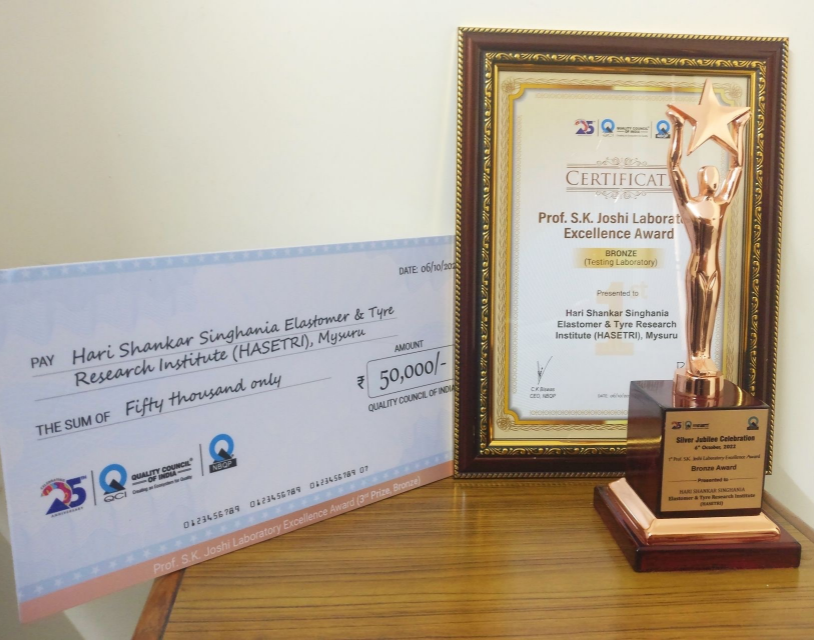
HASETRI receives the Prof. SK Joshi Laboratory Excellence Award
HASETRI received Prof. SK Joshi Laboratory Excellence Award from Quality Council of India (QCI) during their Silver Jubilee celebration held on 6th October 2022 at New Delhi. This is the first testing laboratory in private sector in India to receive this Award.

Elastomer And Tyre Research Institute