Polymers and elastomers
- Home
- /
- Working Domain
- /
- Polymers and elastomers

Polymer Testing Services for Quality and Characterisation
Polymer testing helps measure the physical, chemical, thermal and structural properties of polymeric materials. It is usually used to understand how materials behave under different conditions and whether they meet performance, safety and quality requirements.
A polymer testing lab evaluates polymers, rubber compounds, fillers, reinforcement materials, and finished products using standard test methods and advanced analytical equipment. This helps manufacturers confirm material quality, detect defects, and improve product performance.
At HASETRI , polymer testing supports material characterisation, failure analysis, product validation, and research. Testing performed through our NABL accredited testing laboratory follows controlled procedures and calibrated instrumentation to ensure accurate and repeatable results.
What Is Polymer Testing & Why It Matters for Material Characterisation
Polymer testing is the process of analysing the composition, structure, and performance of polymer materials. It helps identify material properties such as strength, durability, elasticity, crystallinity and thermal behaviour.
Material characterisation is important because polymer performance depends on composition, molecular structure, filler dispersion, and processing conditions. Even small variations can affect durability, adhesion, and mechanical strength.
5 Ways Polymer Testing Helps Enhance Material Quality & Performance:
- Identify polymer type and chemical composition
- Evaluate mechanical and physical properties
- Measure viscosity and processing behaviour
- Determine crystallinity and molecular structure
- Detect contamination and material defects
Techniques such as FTIR, GC-MS, XRD, and microscopy provide detailed information about polymer structure and composition. This data helps engineers select suitable materials and improve product reliability.
Without proper polymer testing, it is difficult to predict material behaviour and long-term performance.
Advanced Polymer Testing Services and Techniques
A polymer testing laboratory uses multiple techniques to analyse material performance and behaviour. These tests help evaluate polymers at chemical, physical and structural levels.
Common Testing Services Used Across rubber, polymer, and allied industries
Chemical and analytical testing
- Polymer identification using FTIR
- Molecular weight and distribution using GPC
- Chemical composition analysis using GC-MS and HPLC
- Elemental analysis using ICP-OES and NCS systems
Thermal testing
- Glass transition temperature and melting point using DSC
- Thermal stability and decomposition using TGA
- Cure behaviour and thermal transitions
Physical and mechanical testing
- Tensile strength, tear resistance, and elasticity using Universal Testing Machine
- Hardness, density, and resilience measurement
- Compression set and deformation analysis
- Abrasion resistance testing
Viscoelastic and rheological testing
- Mooney viscosity measurement
- Rheometric analysis for curing behaviour
- Dynamic Mechanical Analysis (DMA) to measure stiffness and damping
These tests help evaluate polymer durability, processing behaviour, and performance under real conditions.
Cutting-Edge Testing Equipment Used in Polymer Analysis
A polymer testing lab uses specialised instruments to analyse material structure, morphology and performance. These tools help measure properties at microscopic and molecular levels.
Transmission Electron Microscope (TEM)
TEM helps analyse particle size, morphology, dispersion, and crystal structure. It provides detailed information about material composition and nanostructure.
Field Emission Scanning Electron Microscope (FESEM) with EDS
FESEM is used to study surface morphology and identify material defects, contamination, and filler distribution.
Atomic Force Microscopy (AFM)
AFM provides high-resolution surface images and also comes into play when measures mechanical properties such as stiffness and adhesion.
X-Ray Diffractometer (XRD)
XRD helps determine crystallinity, molecular orientation, and structural properties of polymers.
Universal Testing Machine (UTM)
UTM measures tensile strength, elasticity, deformation, and tear resistance.
Dynamic Mechanical Analyzer (DMA)
DMA evaluates viscoelastic properties such as stiffness, damping and temperature-dependent behaviour.
These instruments allow accurate analysis of polymer structure and performance.
How Polymer Testing Ensures Material Quality and Reliability
Polymer testing usually helps to ensure that materials meet required quality and performance standards. It provides measurable data to support material selection and also when it comes to process control.
Polymer testing ensures quality by:
- Verifying raw material composition
- Confirming mechanical strength and durability
- Detecting defects and contamination
- Evaluating resistance to wear, fatigue, and ageing
- Validating curing and processing conditions
Fatigue and fracture testing helps predict crack growth and material failure under cyclic loading. Weathering and ageing tests help evaluate durability under environmental conditions such as heat, oxygen and ozone exposure.
Testing also helps confirm consistency between production batches.
How Polymer Testing Ensures Performance of Fillers, Reinforcements, and Composites
Polymer testing is not limited to base polymers. It also evaluates fillers, reinforcement materials, and composites that affect final product performance. These components play a major role in strength, durability and long-term reliability.
Fillers such as carbon black and silica are commonly used in polymer compounds. Their properties influence wear resistance, mechanical strength and processing behaviour. Polymer testing helps measure filler dispersion, particle distribution, surface area, and chemical composition. This ensures the filler is suitable for the intended application.
Reinforcement materials such as steel cords, bead wires, and textile cords are also tested. These materials provide structural strength in reinforced products like tyres and industrial components. Polymer testing helps evaluate tensile strength, adhesion, elongation, and fatigue resistance of reinforcement materials.
Adhesion testing is especially important. Poor bonding between reinforcement and polymer can sometimes lead to early failure in our processes. Testing also lets us confirm that reinforcement materials perform correctly under load and environmental conditions.
Polymer testing is also used for composite materials. It helps analyse mechanical behaviour, structural integrity, and resistance to fatigue and wear. This ensures that composite materials meet required performance standards.
This level of testing helps improve product durability, safety and long-term performance.
Role of Polymer Testing in Enhancing Product Performance and Safety
Polymer performance affects the safety and durability of many products, including tyres, seals, hoses and industrial components. Polymer testing helps ensure these materials perform correctly under load and environmental stress.
Polymer testing improves performance and safety by:
- Evaluating strength and durability of polymer materials
- Ensuring proper adhesion between reinforcement and polymer
- Measuring fatigue resistance and crack growth behaviour
- Improving resistance to abrasion and wear
- Supporting product design and validation
Testing also helps optimise material formulation, filler selection and processing conditions. This leads to improved durability and longer service life.
Reinforcement testing, including steel cords, bead wires, and textile cords, helps evaluate adhesion, strength and fatigue behaviour. These properties are critical for structural integrity and product reliability.
Contact us to discuss your polymer testing requirement and material characterisation needs.
Advanced Polymer Testing Lab for Polymer and Elastomers
Natural and synthetic rubbers are both commonly employed in rubber products and different blends are also used to satisfy the design demand of various components of a tyre. HASETRI operates as a dedicated elastomer testing lab for complete rubber and polymer characterisation.
Dirt content, ash content, volatile matter, Mooney viscosity, oil content, metal content, mixed organic acid and soap content, cis trans vinyl styrene content (microstructure), glass transition temperature, molecular weight distribution, Mw, Mn, Mz, polydispersity index are all important parameters which affect different aspects of processing and end product properties.
We offer complete testing, analysis, and problem solving for natural and synthetic rubbers under a single roof.
- Ash content
- Dirt Content
- Volatile Content
- Mooney Viscosity
- Oil content
- Metal content
- Nitrogen content
- Organic acid and soap content
- Micro structure (cis, trans and vinyl content)
- Glass transition temperature
- Molecular weight distribution
Frequently Asked Questions
What is polymer testing?
Polymer testing evaluates the physical, chemical, thermal, and mechanical properties of polymeric materials to confirm quality, detect defects, and verify performance against required standards.
What does a polymer testing laboratory analyse?
A polymer testing laboratory analyses raw polymers, rubber compounds, fillers, reinforcement materials, and finished products using standardised test methods and calibrated instruments for accurate, repeatable results.
What instruments are commonly used in polymer testing?
Common polymer testing instruments include FTIR spectrometers, GPC systems, DSC, TGA, Universal Testing Machine, DMA, FESEM, and XRD diffractometers for chemical, thermal, and structural analysis.
What polymer testing equipment is used for mechanical evaluation?
Mechanical polymer testing equipment includes Universal Testing Machines for tensile and tear strength, Dynamic Mechanical Analyzers for viscoelastic behaviour, and hardness testers for rubber and compound evaluation.
Why is NABL accreditation important for a polymer testing lab?
NABL accreditation ensures a polymer testing lab follows standardised procedures, uses calibrated equipment, and delivers results accepted by regulators, OEMs, and certification authorities in India and internationally.
Which industries require polymer testing services?
Polymer testing services are essential for tyre manufacturing, automotive components, industrial rubber goods, aerospace, medical devices, and construction for material validation, quality assurance, and regulatory compliance.
Highlights

HASETRI featured in Indian/International Rubber Journal
An enlightening interview with Dr. R. Mukhopadhyay, Director & CE, HASETRI, speaks of the current situation of the Indian tire and rubber industry and how they are coping with the pandemic.

HASETRI successfully enhanced the scope of NABL accreditation
September 2021: HASETRI has successfully enhanced the scope of NABL accreditation in Wet Grip and Coast by Noise testing for Cl & C2 category tyres as per ECE R117 and proposed AIS 142.

PHD Annual Awards for Excellence Announced
HASETRI imparted training to candidates under the STAR scheme of NSDC,GOI in rubber sector(under Rubber SDC)for the job roles of mill & Tyre Building Operator-commercial vehicles. The Institute has been approved as the first training provider for rubber sector by RSDC under NSDC,GOI
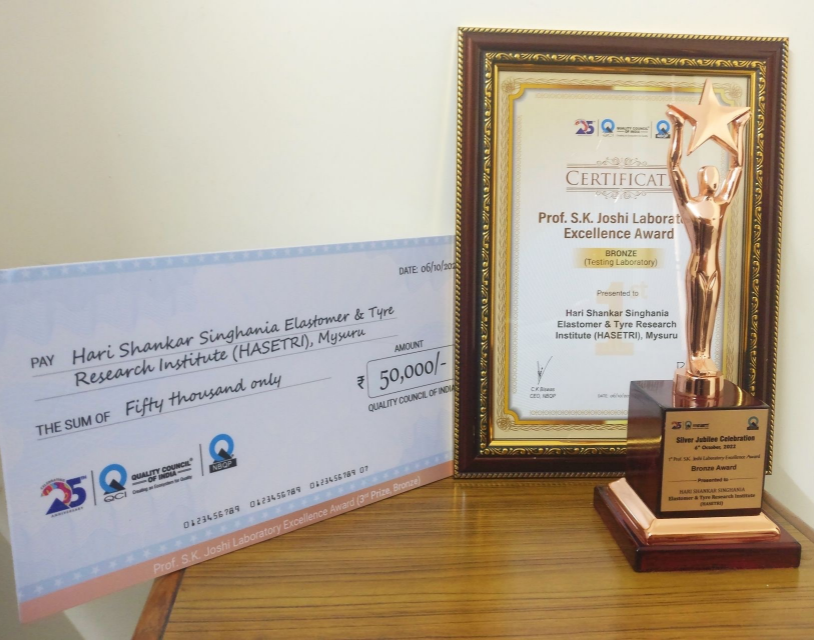
HASETRI receives the Prof. SK Joshi Laboratory Excellence Award
HASETRI received Prof. SK Joshi Laboratory Excellence Award from Quality Council of India (QCI) during their Silver Jubilee celebration held on 6th October 2022 at New Delhi. This is the first testing laboratory in private sector in India to receive this Award.

Elastomer And Tyre Research Institute