Noise, Vibration & Harshness Testing
- Home
- /
- Working Domain
- /
- Noise, Vibration & Harshness...
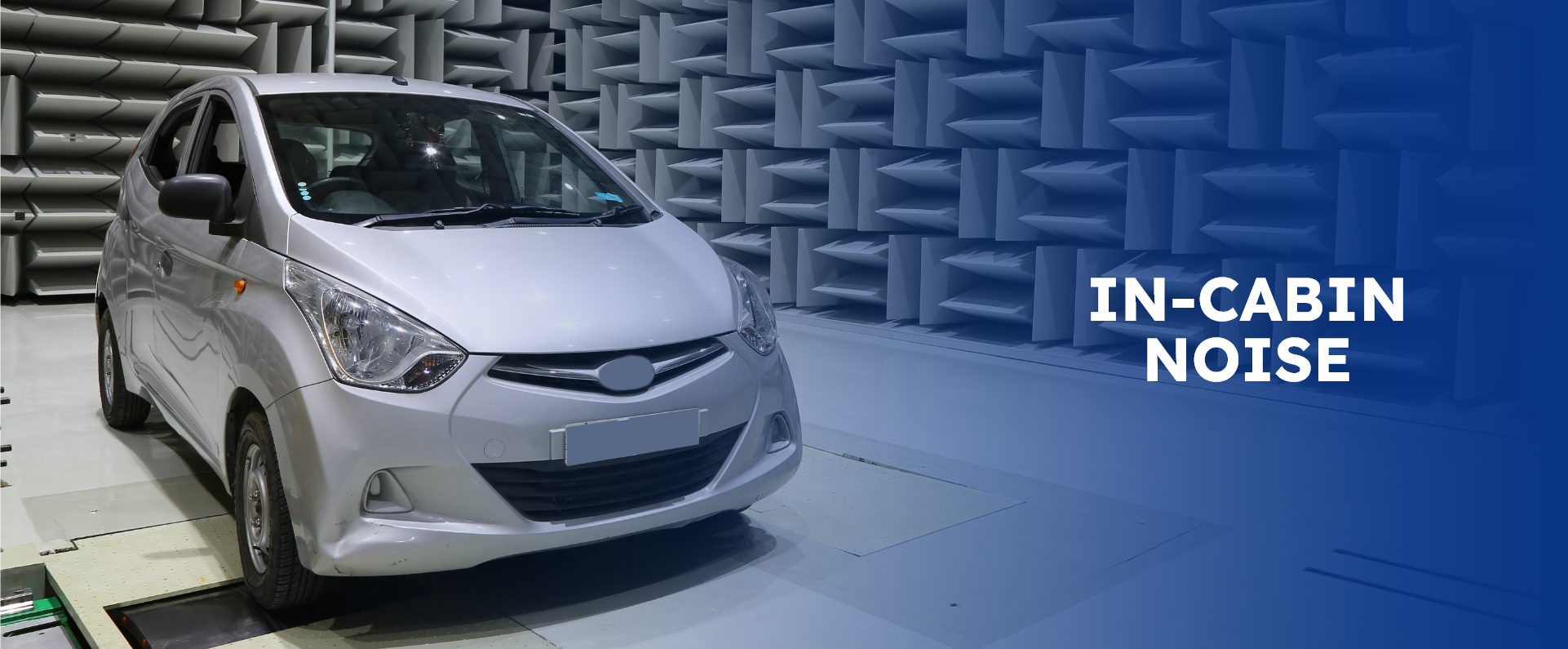
NVH Testing Services for Noise, Vibration & Harshness Analysis
NVH testing measures noise, vibration and harshness in vehicles and tyres. It helps engineers understand how a vehicle sounds and feels during operation. NVH affects comfort, safety perception, and overall product quality.
Noise and vibration can come from tyre-road interaction, suspension behaviour, chassis response and structural resonance. NVH testing captures this data under controlled indoor and outdoor conditions. The results help improve ride comfort, reduce unwanted noise and optimise vehicle behaviour.
At HASETRI , NVH testing supports tyre manufacturers, automotive OEMs and component suppliers. Testing is conducted using calibrated systems and defined protocols for repeatable setups.
Understanding about NVH Testing Services and Their Importance
NVH testing focuses on how sound and vibration travel through a vehicle. It measures both airborne noise and structure-borne vibration. In-cabin noise is one of the most important comfort parameters. The noise experienced inside the vehicle depends on tyre design, suspension setup, structural behaviour and road interaction.
5 Key Benefits of NVH Testing for Superior Vehicle Comfort & Refinement
- ● Identify dominant noise sources
- ● Measure vibration levels at different vehicle points
- ● Evaluate tyre contribution to cabin noise
- ● Improve ride comfort and refinement
- ● Support benchmarking and troubleshooting
With the rise of electric vehicles, tyre noise becomes more noticeable because engine noise is minimal. This makes NVH testing more critical than before. Indoor NVH testing is conducted inside a semi-anechoic chamber. The chamber is acoustically and mechanically isolated from surroundings. This allows accurate and repeatable measurements.
Indoor NVH testing includes:
- ● In-cabin noise measurement on drum setup
- ● Tyre modal analysis as per SAE standards
- ● Tyre noise measurement and cavity noise study
- ● Tyre force and moment testing under controlled conditions
Noise can be analysed using FFT or 1/3 octave maps. Controlled temperature and isolation ensure data quality.
Contact us to plan your NVH testing program for tyre or vehicle validation.
Standard NVH Testing Methods and Measurement Protocols
NVH testing follows defined procedures to ensure accuracy and repeatability. Both indoor and outdoor NVH testing methods are used depending on the objective.
4 Core Indoor NVH Testing Techniques for Tyre Noise & Vibration Evaluation:
- ● In-Cabin Noise Measurement:
Conducted in a semi-anechoic chamber using drum setup. Engine influence is removed to isolate tyre-road interaction.
- ● Tyre Modal Analysis:
Modal frequencies, damping, and mode shapes are extracted. Results can be compared with finite element models.
- ● Tyre Noise Measurement:
Measures overall noise level and frequency response under controlled speed and load.
- ● Tyre Force & Moment (F&M) Testing:
Measures forces (Fx, Fy, Fz) and moments (Mx, My, Mz) under various operating conditions.
Outputs include:
- ● Cornering stiffness
- ● Aligning stiffness
- ● Peak lateral force
- ● Conicity and plysteer
- ● Dynamic loaded radius
5 Core Outdoor NVH Testing Techniques for Tyre Noise & Vibration Evaluation:
- ● Outdoor In-Cabin Noise Testing:
Conducted on test tracks using sensors and data acquisition systems.
- ● Pass-by Noise Testing:
Measures noise experienced by pedestrians as vehicle passes. Weather conditions and trigger systems ensure quality data.
- ● Tyre Force & Moment on Real Ground:
Characterises tyre behaviour under real road conditions. Includes rolling resistance and grip index testing.
- ● Steering Response Analysis:
Steering robot performs repeatable manoeuvres such as pulse steer, sine with dwell and on-centre handling tests.
- ● Manoeuvring and Fuel Efficiency Analysis:
Includes braking, slalom, double-lane change and fuel consumption measurement.
These NVH testing methods help engineers connect lab data with real-world vehicle behaviour.
NVH Testing Equipment and Data Analysis Systems
Accurate NVH testing depends on reliable measurement systems. Noise and vibration levels are often small but critical. Even minor variation in setup can change results. Testing conducted through our NABL lab helps ensure calibrated processes, repeatable measurements, and reliable engineering data.
At HASETRI, NVH testing equipment includes:
- ● Semi-anechoic chamber
- ● Microphones
- ● Accelerometers
- ● FFT analyser
- ● Pulse multi analyser
- ● LMS data acquisition system
- ● Impact hammer
- ● Wheel force transducer
- ● Steering robot
- ● Skid trailer
- ● Fuel flow meter
5 Ways Reliable NVH Data Helps Engineers Eliminate Noise & Improve Ride Refinement
- ● Identify root causes of unwanted noise
- ● Improve ride refinement
- ● Adjust tyre design parameters
- ● Modify suspension tuning
- ● Reduce vibration transfer paths
Applications of NVH Testing Across Automotive Segments:
Passenger Vehicles:
Focus on cabin comfort, reduced tyre noise and improved ride refinement.
Commercial Vehicles:
Focus on durability, structural vibration, and stability under high loads.
Two-Wheelers:
Focus on vibration control and ride stability.
Electric Vehicles:
Tyre noise becomes dominant due to low engine sound. NVH testing helps reduce tyre-generated noise.
Tyre Manufacturers:
Used to evaluate tyre modal behaviour, cavity noise, rolling resistance and force & moment characteristics.
Component Manufacturers:
Used to study structural vibration and resonance behaviour. Rubber and elastomer components used in mounts and isolators can be further evaluated at our elastomer testing lab for material-level characterisation.
Professional NVH Testing for Indoor Noise, Vibration & Harshness
In-Cabin Noise is an important parameter regarding the comfort of Passengers and Driver. The noise and vibration experienced inside the cabin is dependent on tyre as well as the vehicle properties.
HASETRI’s ISO certified semi Anechoic chamber provides the ideal environment to measure the NVH properties inside the vehicle cabin. The chamber houses single drum (which is soon to be upgraded to two) on which the front/rear wheels shall be driven. This eliminates the need of engine drive thereby making Tyre- Road wheel interaction the major parameter influencing the in-cabin noise and vibrations. The in-cabin measurement can be done and studied for Benchmarking and Troubleshooting purposes.
The Chamber can house even a small Truck inside comfortably for measurements. Noise can be plotted as FFT or 1/3rd Octave Maps for analysis. The chamber, being acoustically and mechanically isolated from the surroundings ensures quality data and is repeatable due to controlled parameters inside the chamber.
Reach out to schedule NVH testing and improve noise, vibration and handling performance.
Frequently Asked Questions
NVH (Noise, Vibration, Harshness) refers to vehicle comfort and performance: Noise: Sound from components like engines or exhaust; unwanted noise can be distracting. Vibration: Oscillations felt through the steering, seats, or chassis from engines, tires, or suspension. Harshness: Overall rough or uncomfortable ride sensation, influenced by suspension and road conditions.
NVH testing evaluates vehicle noise, vibration, and harshness. Vehicles, components, or subassemblies are exposed to vibrations across frequencies to identify issues like buzzes, squeaks, and rattles. Instruments such as microphones, accelerometers, and force gauges capture data, often in semi-anechoic chambers or on road simulators. Improvements focus on reducing noise at the source, blocking transmission paths, or absorbing energy, using techniques like modal analysis, transfer path analysis, and part substitution.
NVH testing evaluates vehicle comfort and performance through several methods. It captures noise and vibration using sensors, identifies natural frequencies via modal analysis, assesses sound quality beyond loudness, and performs specific tests like squeak and rattle, transfer path analysis, and road simulations. Physical testing is often combined with simulations, with advancements focusing on electric and hybrid vehicles using real-time data and advanced signal processing.
In-cabin noise analysis identifies and reduces unwanted sounds. It examines noise sources such as tires, engine, wind, and structural vibrations; uses microphones, accelerometers, and data acquisition systems for measurement; and applies signal processing like FFT and one-third octave band analysis. Noise paths are traced to understand transmission, while reduction strategies include sound absorption, insulation, damping, and vibration isolation. Acoustic modeling with BEM or FEM helps optimize control, contributing to overall NVH improvement and cabin comfort.
In-cabin noise analysis is crucial for vehicle quality. It enhances passenger comfort, reduces fatigue, and improves the driving experience; increases safety by minimizing distractions; ensures compliance with noise regulations; and helps vehicles stand out in the market with a quieter cabin.
Highlights
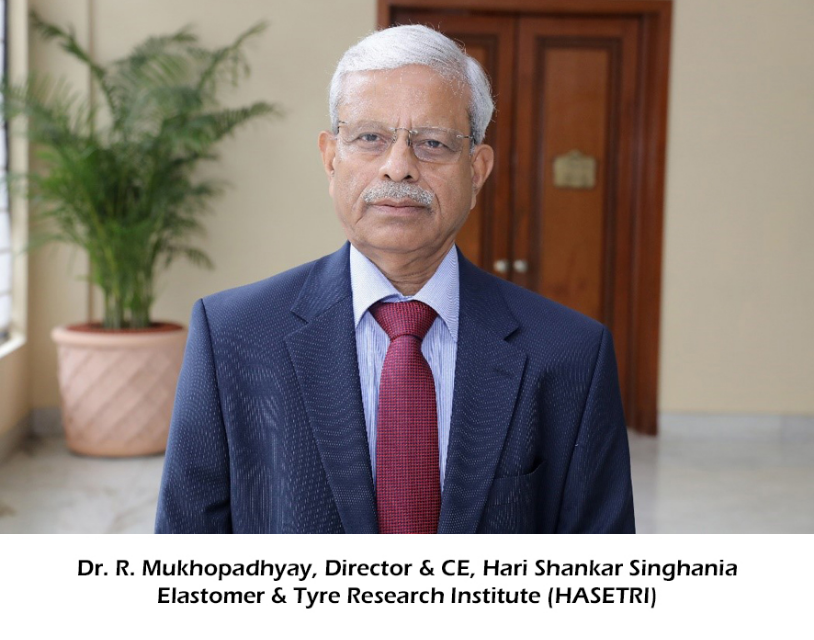
HASETRI featured in Indian/International Rubber Journal
An enlightening interview with Dr. R. Mukhopadhyay, Director & CE, HASETRI, speaks of the current situation of the Indian tire and rubber industry and how they are coping with the pandemic.
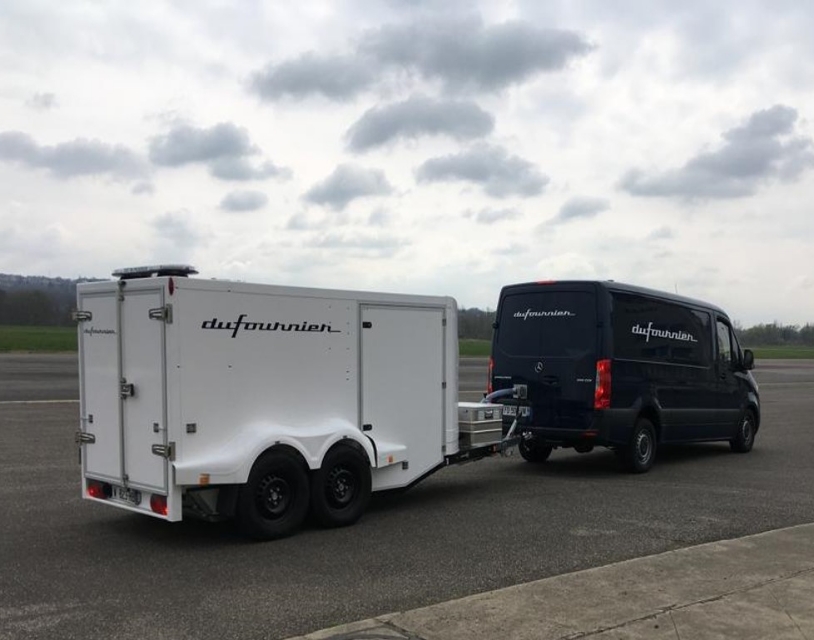
HASETRI successfully enhanced the scope of NABL accreditation
September 2021: HASETRI has successfully enhanced the scope of NABL accreditation in Wet Grip and Coast by Noise testing for Cl & C2 category tyres as per ECE R117 and proposed AIS 142.
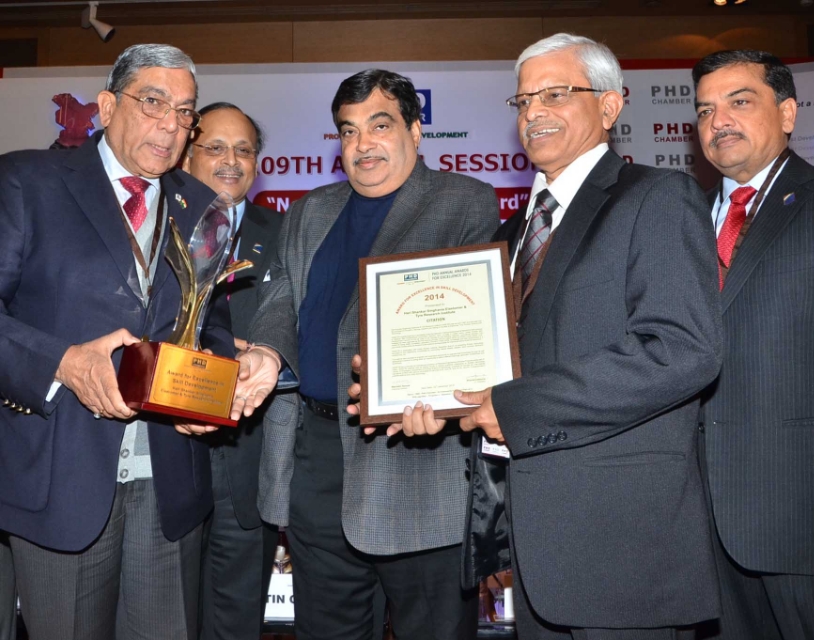
PHD Annual Awards for Excellence Announced
HASETRI imparted training to candidates under the STAR scheme of NSDC,GOI in rubber sector(under Rubber SDC)for the job roles of mill & Tyre Building Operator-commercial vehicles. The Institute has been approved as the first training provider for rubber sector by RSDC under NSDC,GOI
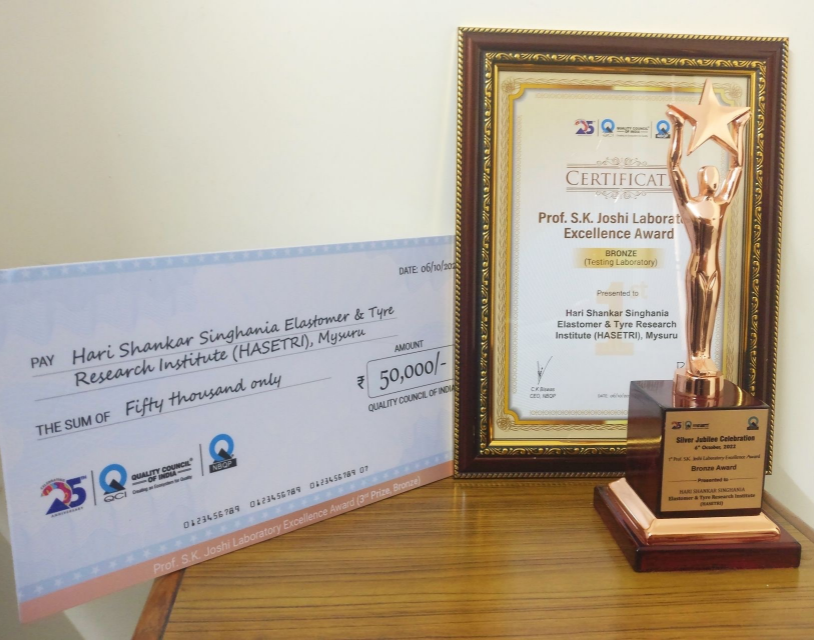
HASETRI receives the Prof. SK Joshi Laboratory Excellence Award
HASETRI received Prof. SK Joshi Laboratory Excellence Award from Quality Council of India (QCI) during their Silver Jubilee celebration held on 6th October 2022 at New Delhi. This is the first testing laboratory in private sector in India to receive this Award.

Elastomer And Tyre Research Institute